Choosing the right grow lights for plants is the single most crucial factor for healthy, high-yield growth. Whether you're running a commercial facility or a personal tent, your harvest will suffer from poor lighting. Don't let months of hard work go to waste with an inadequate spectrum.
With over 25 years of experience, BioFloral is Canada’s trusted source for the best grow lights for indoor plants. We offer a curated selection of LED grow lights for indoor plants, HPS, and ceramic options for every type of grower.
In this guide, you’ll discover the leading solutions for 2026. We’ll compare top HPS, metal halide, ceramic, and hybrid options, breaking down their features and ideal applications to help you grow like a pro.
Quick-Glance: Top Grow Lights for 2026
|
Product Name |
Type |
Best For |
Key Feature |
|
Ushio Proplus HPS AHS DE |
HPS (DE) |
Commercial Flowering |
High PAR, Long Lifespan |
|
Ushio Hilux Gro™ 1000W DE |
Metal Halide (DE) |
Pro Full-Cycle |
Uniform Output |
|
Hortilux Super HPS |
HPS |
Heavy Yields |
25% More Light Energy |
|
Hortilux Metal Halide |
Metal Halide |
Vegetative Growth |
Natural Sunlight Mimic |
|
SunBlaster Prismatic LED |
LED Striplight |
Propagation/Microgreens |
90° Prism Lens, 20% More Light |
|
GLS ProGrow 820W 2400 LED |
LED (Folding) |
High-End Home Grow |
Commercial-Grade PPFD |
|
Philips 400W MH |
Metal Halide |
Home Vegetative |
Balanced Spectrum |
|
Hortilux 600W HPS Ceramic |
Ceramic HPS (DE) |
Commercial Flowering |
Broad Spectrum Density |
What Makes a Great Grow Light?
When searching for the best grow lights, you need to look beyond just wattage. Lighting plays a critical role in regulating plant growth and sugar metabolism. To maximize your brix levels and biomass, consider these factors:
-
PAR Output: Photosynthetically Active Radiation (PAR) measures the light plants actually "see" and use for photosynthesis.
-
Full Spectrum Grow Lights: Plants need different wavelengths at different stages. Blue light (400-500nm) is vital for leafy growth, while red light (600-700nm) triggers heavy flowering.
-
Heat Management: High-intensity plant grow lights generate heat. Managing this is crucial for maintaining terpene profiles and preventing leaf burn.
HPS vs. Metal Halide vs. LED
Commercial growers often prefer Double-Ended (DE) HPS for their unmatched intensity during bloom. Home growers are increasingly turning to led grow lights for indoor plants for their energy efficiency and lower heat signatures. Ceramic and Hybrid options bridge the gap, providing a "best of both worlds" full spectrum grow lights solution.
Top Picks: Detailed Reviews
For Commercial Flowering: Ushio Proplus Bulb 1000W HPS AHS-DE

This is a powerhouse for large-scale operations. The double-ended design provides significantly higher PAR than traditional single-ended bulbs.
-
Key Features: Enhanced red/blue spectrum for intense flowering and long-term lumen maintenance.
-
Pros: Extreme light intensity and consistent performance over multiple cycles.
-
Cons: Requires a specific DE fixture and significant ceiling height.
For Pro Full-Cycle: Ushio Hilux Gro™ 1000W DE Metal Halide

Expanding its renowned line, this lamp is built for professional applications that require a balanced, sun-mimicking spectrum throughout the entire life cycle.
-
Key Features: High PAR output up to 1800 μmol/s and 5500K color temperature.
-
Pros: Uniform distribution pattern ensures no "dead zones" in the canopy.
For Heavy Yields: Hortilux Super HPS Grow Light

Hortilux is legendary in the industry. Their Super HPS provides 25% more light energy in the violet, blue, and green spectrums than standard HPS bulbs.
-
Key Features: "Multi-cycle" use capability and a spectrum optimized for fruit and flower density.
-
Pros: Proven track record for the heaviest harvests in the business.
For Propagation & Microgreens: SunBlaster Prismatic LED 24W 2' HO Striplight 6400K

This model represents the next generation of led grow lights for indoor plants. Unlike standard LEDs, this unit features a prismatic lens that focuses light into a 90-degree beam angle, delivering 20% more light energy directly to the canopy.
-
Key Features: 3400 lumens, 6400K full spectrum, and patented self-cooling technology that eliminates the need for noisy fans.
-
Pros: Faster growth for clones and seedlings, energy-efficient, and daisy-chainable (up to 8 units).
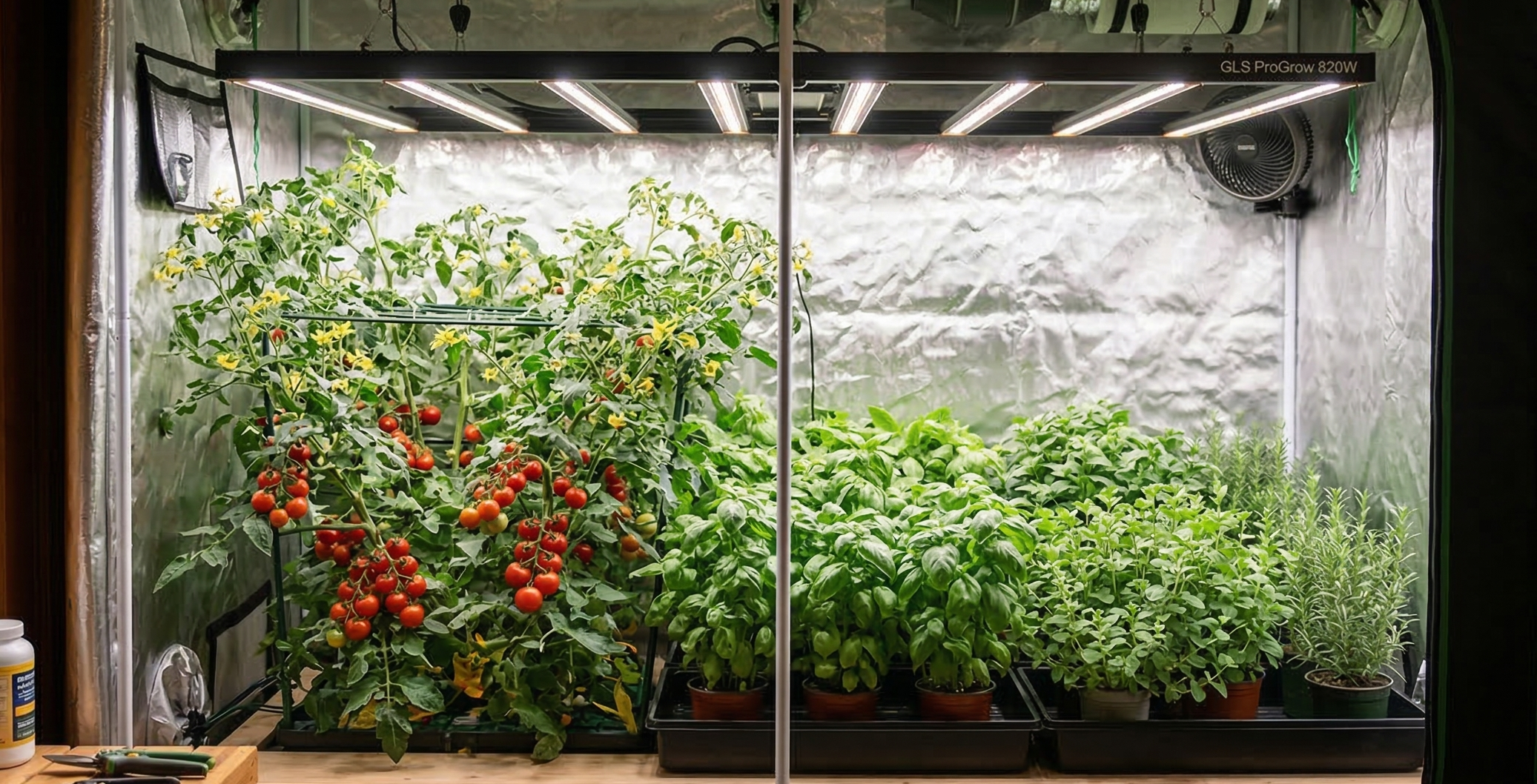
For High-End Home Grow: GLS ProGrow 820W 2400 LED Folding Model

The GLS ProGrow 820W 2400 LED Folding Model brings commercial-grade performance to the residential grower. Engineered for high-output cultivation, it delivers exceptional uniformity and professional-grade PPFD levels.
-
Key Features: Folding design for compact storage, 2,424 µmol/s PPF, and residential voltage compatibility (120–220 V).
-
Pros: Offers the same optical performance as professional fixtures with a "plug and play" setup for home use.
How to Choose the Right Grow Light
-
Assess Your Space: Small tents (under 4x4) are ideal for LED or 400W/600W systems. Larger commercial rooms require the penetration of 1000W DE HPS.
-
Match the Stage: For vegetative growth, focus on high-blue spectrum lights. For flowering, shift to red-rich HPS.
-
Budget for the Long Run: While HPS bulbs are cheaper upfront, LED grow lights for indoor plants save you money on electricity and HVAC cooling costs over time.
Confident Growing Starts at BioFloral
Choosing the best grow lights for indoor plants is an investment in your future harvest. Whether you’re a commercial producer seeking maximum efficiency or a home gardener looking for consistent results, BioFloral has the expertise to light your way.
Ready to see the difference? Explore our full range of lighting and electrical products and take your cultivation to the next level. If you're planning a large-scale facility, reach out to our team for a custom lighting layout and commercial quote today.